The “Throwback Kid” Self-Care Trend: Why Moms Are Healing Through 90s Nostalgia in 2026
The Day I Realized My Self-Care Wasn’t Actually Working
It hit me on a random Sunday afternoon when the house was technically “quiet.”
And if you’re a mom, you already know exactly what that means. It doesn’t mean peaceful. It doesn’t mean still. It means no one is actively yelling at that precise second. The TV is too loud in the other room. There’s a half-eaten snack on the counter that no one has claimed. Someone left the cabinet open again. But for just this one moment, no one needs anything from me.
I had my coffee reheated for the third time that day. The laundry was halfway folded, piled in one of those deceptively promising heaps that somehow multiplies every time I turn my back. My phone was in my hand, and I was scrolling through the same self-care advice I’ve seen approximately one thousand times.
“Take a bath.” “Light a candle.” “Pour a glass of wine.” “Do a ten-minute meditation.” “Journal your feelings.”
And I just remember sitting there, half-folded bath towel in my lap, thinking: why does none of this actually make me feel better anymore?
Not really. Not in the way it’s supposed to.
It felt like I was performing self-care rather than actually feeling it. Like I was checking off boxes on an invisible list. Bath, check. Candle, check. Wine, check. And at the end of it, I was still tired. Still a little hollow. Still waiting to feel like myself again, and not quite knowing where that version of me had gone.
I kept seeing perfectly curated “self-care routines,” and I kept trying them, and I kept ending up feeling vaguely guilty that they weren’t working. Like maybe I was the problem. Maybe I wasn’t relaxing correctly. Maybe I needed a better candle, a fancier bath bomb, a different kind of wine.
And then something happened that I didn’t expect at all.
It happened while I was cleaning out a random junk drawer. You know the one. The drawer in every kitchen that is basically a museum of miscellaneous life. Dead batteries, old takeout menus, a key that unlocks absolutely nothing you can identify anymore.
Buried under all of it, I found one of those old lip balms. The slightly sticky kind, in a tiny round tin that never quite closed right, that smelled like artificial strawberries in the most wonderful, completely-not-real-fruit way possible.
I opened it.
And instantly, I wasn’t standing in my kitchen anymore.
I was ten years old, cross-legged on the carpet, watching cartoons after school. The afternoon light was coming through the blinds at that specific golden angle. I had a snack. I had absolutely nowhere to be. My brain wasn’t running seventeen tabs at once. There was no mental load. No grocery list forming in the background. No guilt for sitting still.
Just me. Just existing. Just completely, effortlessly present.
And standing there in my kitchen, holding a sticky little tin of fake strawberry lip balm, I started to cry. Not sad crying, or not exactly. More like the kind of crying that happens when something true surfaces that you’ve been pushing down for a long time.
Maybe the self-care I actually needed wasn’t more adult. Maybe it was going back to what made me feel safe, light, and like myself in the first place.
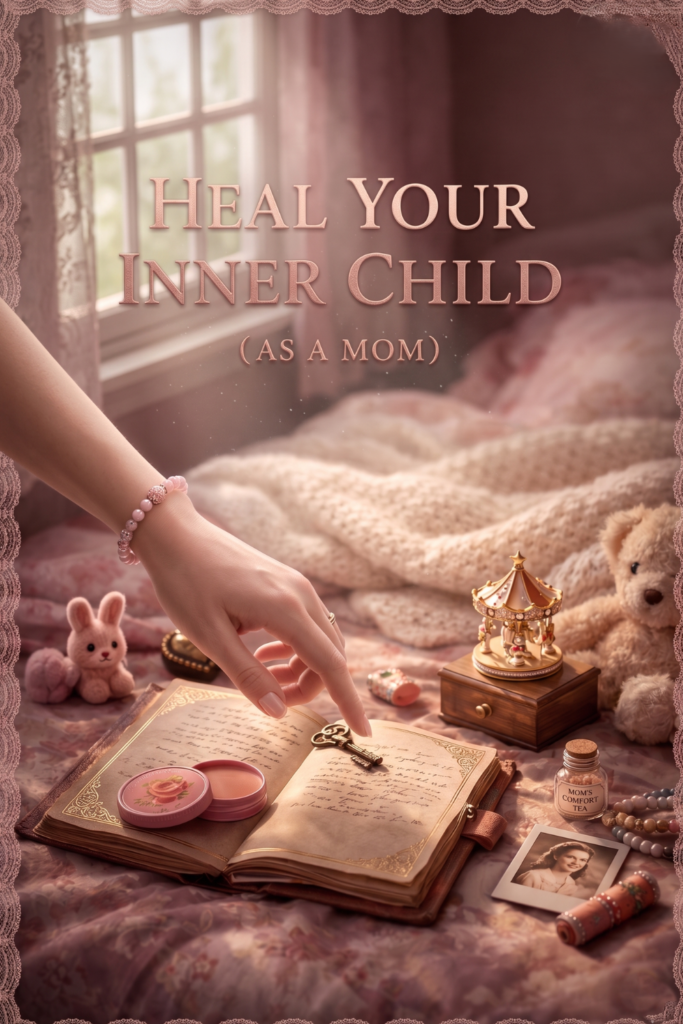
Why “Throwback Kid” Self-Care Is Blowing Up Right Now
If you’ve been anywhere near Pinterest, Instagram, or TikTok lately, you’ve probably felt this wave even if you didn’t have a name for it. A soft, slow, emotional undercurrent of 90s and early 2000s nostalgia that feels less like a trend and more like a collective exhale.
Not the loud, neon, hyper-referential kind of nostalgia. Not the “look at these chunky sneakers and butterfly clips, ha ha, remember the 90s?” kind. That’s not what this is.
This is quieter. More personal. Soft pink filters. Faded photographs. The specific feeling of a Saturday morning when you didn’t have to be anywhere. The smell of a particular shampoo or the sound of a particular song that takes you back to a version of yourself who hadn’t yet learned to feel guilty about resting.
And it’s not just aesthetic, though it is beautiful.
It’s emotional survival.
Here’s what nobody is really saying out loud, but every mom I know is feeling: motherhood in 2026 is relentless in a way that is genuinely hard to explain to anyone who isn’t living it. We are the scheduler, the historian, the emotional regulator, the household manager, the conflict mediator, the pediatric appointment-rememberer, the birthday party planner, the permission slip signer, and the person who knows where everyone’s everything is at all times.
We carry what researchers now call the “cognitive labor” of the family, and it is heavy. Heavier than most people acknowledge. And it’s not just physical tiredness, though there’s plenty of that. It’s the kind of tired that settles into your identity. The kind where you look in the mirror and realize you can’t remember the last time you thought about yourself without also thinking about someone else.
Traditional self-care has become, for a lot of us, another item on an already-overwhelming list. Another thing to optimize, schedule, do correctly, and feel guilty about if we don’t manage to fit it in.
But Throwback Kid Self-Care feels different. And here’s why.
It doesn’t ask you to do more. It invites you to return to a version of yourself that existed before you learned to measure your worth by productivity. Before rest felt like something that had to be earned. Before your brain had a constant background hum of tasks and responsibilities and all the things you haven’t gotten to yet.
It reconnects you with a self who knew, instinctively and without question, how to just be.
The Shift: From “Escape” Self-Care to “Return” Self-Care
I want to talk about something that took me a long time to articulate, because I think it’s actually the heart of why this resonates so deeply.
Most mainstream self-care messaging is fundamentally about escape. Escape the noise. Escape the stress. Escape the chaos of your life, even briefly. Get away. Disconnect. Remove yourself.
And I understand the impulse completely. There are days when I would genuinely love to be teleported to a silent room somewhere with no wifi and no one calling my name.
But here’s what I’ve noticed: escape doesn’t actually restore me. I always have to come back. And when I come back, everything is exactly where I left it. The laundry, the permission slips, and the mental load are all waiting. Except now I’ve added a layer of guilt about the time I spent “escaping.”
“Return” self-care is fundamentally different. It’s not about getting away from your life. It’s about going back to yourself, the self that existed before all of this, and remembering that she’s still in there.
It’s about returning to the feeling of being genuinely, unselfconsciously excited about small things. That joy that kids have, where a good snack or a favorite song or a sunny afternoon is just enough, completely and totally enough.
It’s about the comfort of familiar, repetitive rituals that don’t require you to perform or achieve anything.
It’s about the softness of moving at a slower pace without guilt.
It’s about the particular freedom of joy that didn’t need to be earned.
And when you think about children, actual children, your children, the child you used to be, they don’t need to be taught how to rest. They don’t schedule it. They don’t wonder if they deserve it. They just do it. They sit. They play. They exist in the present moment with a completeness that most adults spend years of meditation trying to get back to.
We were like that once. Every single one of us.
Somewhere along the way, through years of doing, achieving, performing, giving, we lost access to that.
And this trend? This gentle, nostalgic, cozy little trend that’s taking root in tired mom communities everywhere? It’s helping us find it again.
What “Throwback Kid” Self-Care Actually Looks Like in Real Life
Let me paint you a picture of what this actually looks like for me, and I want to be very clear that it is not a perfect picture. It is not an aesthetic. It is not something I Instagram.
It’s Sunday. The kids are occupied, which in my house means they’re probably doing something I’ll regret not supervising, but I’m choosing to trust the silence. The kitchen is not clean. I’m not glowing or calm or transformed. I look the same as I always look on Sunday afternoons, which is “a person who has been managing other people’s needs since 6:45 AM.”
But I’ve built this ritual over the past few months, quietly and imperfectly, and it has changed something in me that I didn’t know needed changing.
Building a Throwback Kit
Nothing fancy. I cannot stress this enough. Nothing was curated or purchased specifically for this purpose or arranged on a shelf for a photo.
Just things that make my brain say: Oh. I remember this version of me.
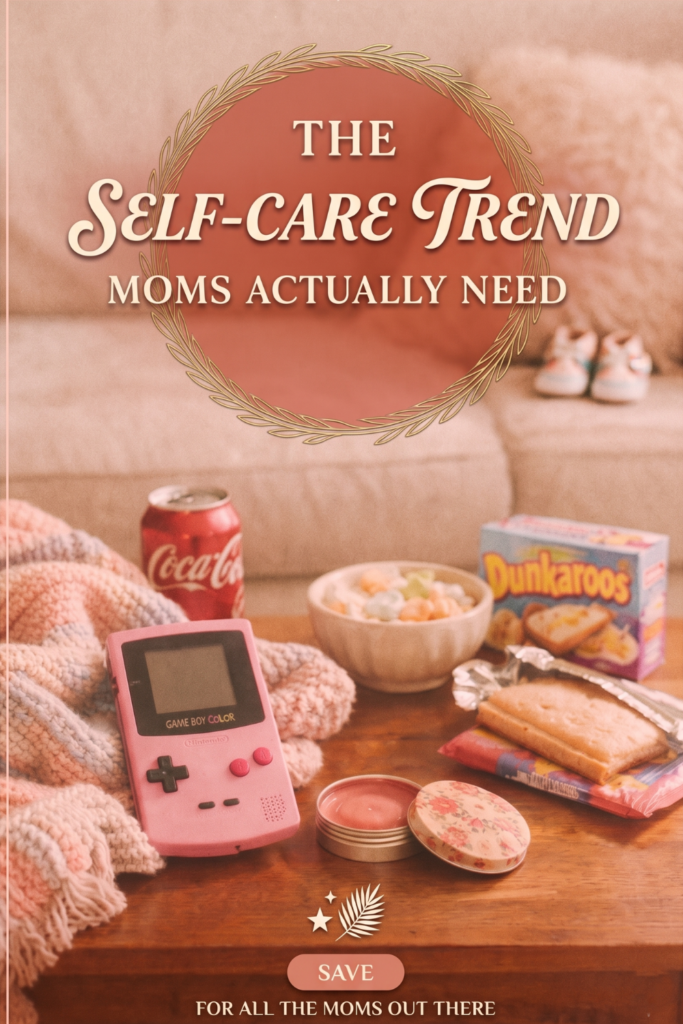
For me, it includes a snack I loved as a kid, something specific enough to actually trigger the memory. A particular candy, a specific kind of chip, and the cereal I wasn’t allowed to have very often. Something that smells like Saturday morning.
It includes a blanket that feels like comfort with no strings attached. Not the decorative throw that’s actually kind of scratchy. The soft, slightly-too-big one that serves no purpose except feeling good.
And here’s the part that took me the longest to add: something to play with, not just consume.
Because there’s a difference, and I think it’s important. Watching TV is consumption. Scrolling on your phone is consumption. But doing a puzzle, playing a simple game, drawing without any goal, making something with your hands, that’s engagement. That’s presence. That’s the thing that actually quiets the mental noise in a way that passive consumption just doesn’t.
The Permission to Be Unproductive On Purpose
This is the hardest part. Genuinely.
Because the whole time, and I mean the whole time, at least at first, there is this voice in the back of your head. And if you’re a mom, you know exactly which voice I mean.
“You should be doing something else.” “You’re wasting time.” “The laundry isn’t done.” “You haven’t answered that email.” “You don’t deserve this yet.”
And here’s what I want you to know, because it took me longer to learn than it should have:
That voice is lying to you.
Not metaphorically. Not in a “well, it has a point, but let’s reframe it” way. That voice is simply, factually wrong. You do not have to earn rest. You did not become undeserving of joy the day you became responsible for other people’s lives. Those two things, your needs and your responsibilities, are not in competition with each other.
That voice gets quieter the more you refuse to obey it.
And in the silence it leaves behind, little moments of actual joy start coming back. Not dramatic, life-changing revelations. Small, steady ones. The particular pleasure of getting lost in something simple. Laughing at something ridiculous without immediately catching yourself. Feeling present in your body instead of just present in your to-do list.
It feels like finding a door you forgot existed.
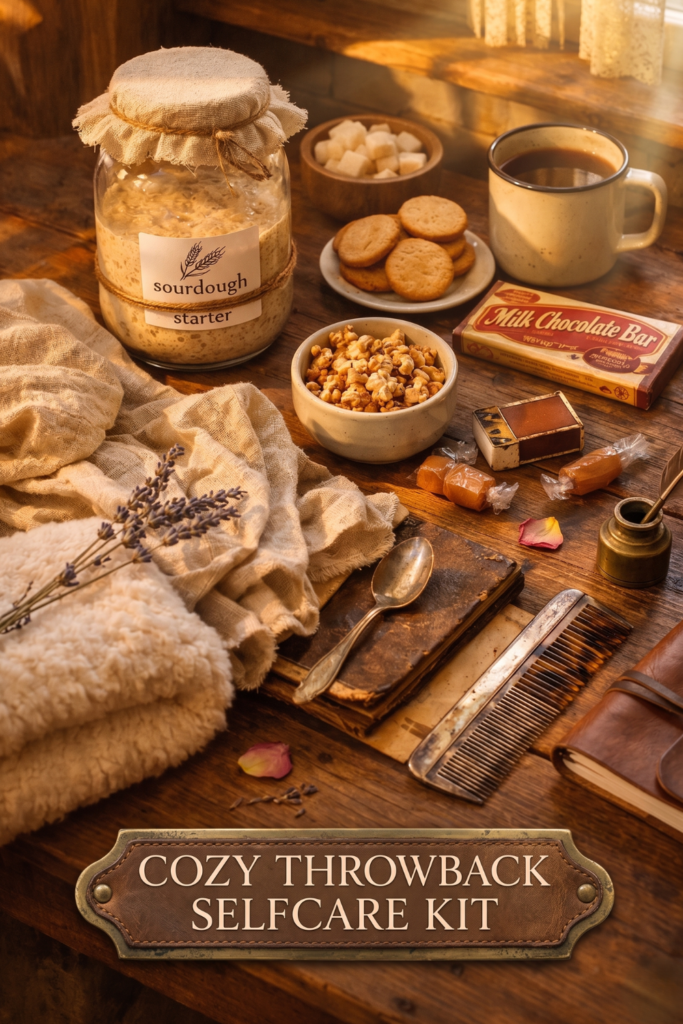
The Sourdough Connection (This is Going to Sound Weird)
I want to tell you about my current obsession, because I think it illustrates something important about what this kind of self-care actually does.
I started baking sourdough.
Not because it’s trendy, though, yes, I am aware it is very trendy. Not to make beautiful artisan loaves for Instagram. Not even because I particularly care about the bread.
I started it because sourdough forces you to slow down in a way that almost nothing else in modern life does.
You have to feed the starter. You have to wait. You have to check in. You have to pay attention to something slow and living and patient. You have to trust a process that cannot be rushed, cannot be optimized, cannot be completed in the margins of a busy afternoon. It takes days. It requires presence.
And there’s something about that rhythm, the daily check-in, the slow rise, the warmth and the smell and the quiet waiting, that feels genuinely nostalgic. It feels like the pace of a childhood afternoon. Like the specific luxury of time that wasn’t scheduled to the minute.
Feeding a sourdough starter, I realized, feels oddly similar to how I want to care for myself right now. Gently. Consistently. Patiently. Without demanding results on an impossible timeline.
It’s not about the bread. It was never really about the bread.
The Unexpected Emotional Side of This (Nobody Warns You)
I want to be honest with you here, because I don’t see enough people talking about this part.
When you start doing this, when you genuinely start reconnecting with your throwback kid self, it can get emotional in ways you don’t expect.
Because you don’t just remember the fun. You remember who you were.
You remember the version of yourself who had opinions about things that had nothing to do with anyone else’s needs. Who had hobbies that existed purely because they brought you joy. Who daydreamed. Who wasn’t always thinking about what came next.
You remember what it felt like to be cared for, rather than always being the one doing the caring.
And there’s a grief in that recognition, a real and valid grief, for the years spent setting yourself down so consistently that you almost forgot where you put yourself.
I want you to sit with that for a second, because I think a lot of us rush past it. We feel the ache of it, and we immediately pivot to “but it’s fine, I love my kids, I wouldn’t change anything.” And both things can be true. You can love your life and also grieve the parts of yourself that got quietly buried under it.
That grief is not a complaint. It’s not ingratitude. It’s just honest.
But here’s the other thing, the thing that makes this worth it:
That version of you is not gone.
She didn’t disappear. She didn’t die when you became a mother. She just got buried under years of responsibility, doing, giving, and managing. She has been there the whole time, a little quieter now, waiting for you to come back and check on her.
And this kind of self-care? This nostalgic, cozy, small, and unhurried kind? It’s how you go back and find her.
The Inner Child Piece: What It Actually Means (And What It Doesn’t)
“Inner child healing” gets thrown around a lot in wellness spaces, and I think sometimes it sounds more complicated or more therapeutic than what I’m actually talking about here.
I’m not suggesting you need to do deep psychological work or revisit anything painful from your past. If that resonates for you, it’s genuinely valuable work, but that’s not what this is.
What I mean is simply this: there is a version of you that existed before you learned to perform, achieve, and earn your worth. A version of you that knew, naturally and without instruction, how to play. How to rest. How to be delighted by ordinary things.
And she has something to offer you right now.
Not because the past was perfect, because it wasn’t, no one’s was. But because she carried a relationship with joy and rest and presence that we spend our adult lives trying to reconstruct through productivity hacks, wellness routines, and self-optimization apps.
She didn’t need any of that.
And the truth is: you don’t need to earn your way back to her. You just need to make a little space.
What Your Version Might Look Like (Because It Won’t Look Like Mine)
This is the part I want to emphasize, because I think it’s where most self-care content fails us.
My version of this involves artificial strawberry lip balm, sourdough bread, and a fuzzy blanket, and the specific snacks of my particular 90s childhood. That’s mine. It’s personal and specific, and it works because it’s true to me.
Your version will look completely different, and it should.
Maybe your “throwback kid” moment lives in the music you played on repeat at thirteen. Not because it’s good, it might be objectively terrible, but because it’s yours. It’s the soundtrack to a version of you who had time and space to feel things deeply.
Maybe it’s a craft or hobby you loved before you decided it wasn’t productive enough to justify. Drawing. Friendship bracelets. Collecting something. Learning every word to a movie you watched forty times. Building things just to see if you could.
Maybe it’s a specific sensory memory. The smell of a particular shampoo, a flavor of lip gloss, the feeling of a specific fabric. Something your body remembers even when your brain doesn’t.
Maybe it’s a TV show or movie you watched in a state of pure, unironic engagement. Not background noise. Not multitasking. Actually watching, the way you watched things when you were young enough that watching was, itself, the whole point.
Maybe it’s a game you loved. A place that felt safe. A ritual at your grandmother’s house or your best friend’s kitchen, or your own bedroom at the end of a good day that felt like being wrapped in something warm.
Start there. Start with one true thing, not a curated aesthetic. The more specific, the more personal, the more it’s actually you, the better it will work.
Common Mistakes I Made So You Don’t Have To
Trying to make it aesthetic instead of personal. This is a trap I fell into fast, and I’m going to admit it without shame. I started thinking about how to set it up visually. What would look good? What was Pinterest-worthy? And the moment I did that, I was performing again instead of resting. This is not for the feed. Let it be private and a little embarrassing if that’s what it needs to be.
Turning it into another task. I planned my first throwback Sunday so thoroughly that by the time I sat down to “relax,” I had a schedule. An actual schedule. The irony was not lost on me. Simplify ruthlessly. If it feels like a project, you’re doing it wrong.
Expecting it to fix everything immediately. This is not a dramatic intervention. It’s subtle. It’s quiet. It’s something you’ll probably underestimate the first three or four times you do it. But something accumulates, slowly and steadily, and one day you’ll notice that the voice telling you you haven’t earned rest is a little bit quieter. That’s the win.
Comparing your version to someone else’s. There will always be a mom somewhere on Pinterest whose throwback kit is more beautiful than yours. Whose sourdough rises higher. Whose cozy Sunday looks like a film still. Let her have that. Your messy, imperfect, genuine version is worth more than her perfect one. That’s the one rule I keep coming back to.
A Practical Starting Place: Your First “Throwback Kit”
If you’ve gotten to this part and you’re thinking “okay, I want to try this, but I genuinely don’t know where to begin,” here is the simplest possible starting place.
Get a piece of paper, or a notes app if that’s what’s in your hand right now, and answer this one question:
What made me feel safe, happy, or completely like myself when I was somewhere between the ages of 8 and 14?
Not what was popular. Not what you’re “supposed” to be nostalgic about. Not what shows up on “90s kids will remember this” lists. What was actually yours.
Write down five things. They don’t have to be big. “The smell of my mom’s kitchen on Sunday mornings.” “That one video game I played for three summers in a row.” “The specific feeling of reading in bed on a Saturday with nowhere to be.” “The animated movie I watched approximately 400 times.”
Now pick one. Just one.
Bring one small piece of that back into your life this week. Not a whole ritual. Not a production. One small, specific, personal piece.
That’s the whole starting point.
How to Build This Into Your Life Without It Becoming Another Obligation
This is the practical part, because I know we’re all living in the real world where Sundays are not always soft and slow. Sometimes Sundays are full of sports practices and sibling arguments, and the grocery run you couldn’t fit in on Saturday.
So here’s what I’ve learned about making this actually sustainable:
Keep it flexible, not scheduled. This works better as a permission than an appointment. Give yourself permission to slip into a throwback moment whenever it’s available, not just when you’ve officially carved out the time. Sometimes it’s twenty minutes. Sometimes it’s ten. Sometimes it’s literally just opening that tin of lip balm while the coffee brews and giving yourself thirty seconds of remembering.
Keep the kit somewhere easy to access. Not stored away. Not precious. Somewhere you’ll actually encounter it on an ordinary day.
Remove the conditions. You don’t need the kids to be asleep. You don’t need the house to be clean. You don’t need to have finished everything first. You can take ten minutes in the middle of the chaos, step into a different room, sit down with your blanket and your snack, and just exist for a moment. The world will not end.
Let it evolve. What brings you back to yourself might change over time. Pay attention to what actually works and what’s just an idea of what should work. Stay honest with yourself.
A Letter to the Mom Reading This at 11 PM
I want to close by talking directly to you, because I know who reads blog posts like this at 11 PM.
You’ve been going since before the sun was up. You’ve fed everyone and driven everyone, managed everyone, and remembered everyone’s everything. You’ve had conversations you were too tired to have and handled situations you were too depleted to handle gracefully, and you’ve still, somehow, held it together enough to get everyone to bed.
And now you’re here, in the quiet of the house, reading about self-care and maybe feeling a little bit of that hollow ache that comes from pouring out more than you’ve taken in for a very long time.
I see you.
And I want to tell you something that I needed someone to tell me, clearly and without conditions:
You don’t need to earn rest. You don’t need to become a different person to deserve softness. You don’t need to be more organized or more caught up or more together before you’re allowed to feel like yourself again.
The version of you who knew how to just exist, who could sit in the afternoon light and feel good about it without needing to have done something first, she’s not gone.
She’s been waiting, patiently, for you to come back.
You don’t need a perfect ritual or a beautiful flat lay or the right products or a complete Sunday afternoon. You just need five minutes and one honest, personal, specific thing that takes you back to her.
Start there.
She’ll be glad you did.
Frequently Asked Questions
Is this just another trend that will fade? Maybe. Trends do. But the need behind it won’t, because that need is not about aesthetics. It’s about the genuine exhaustion of modern motherhood and the specific hunger to feel like a full person rather than just a function. That’s not going anywhere. Even when the name changes, the impulse will still be true.
What if I don’t feel nostalgic about my childhood? This is a real and valid question, and I want to answer it carefully. Not every childhood is something you want to return to. If yours was difficult, painful, or something you’ve worked hard to heal from, you absolutely don’t have to go back there. You can use the same principle, reconnecting with an easier, lighter, more playful version of yourself, while drawing on different sources. Maybe it’s a time in your early twenties when you felt free. Maybe it’s about creating the comfort you deserved but didn’t always have. The grief you carry is valid. The softness you get to give yourself now is real.
How long does this need to take to “count”? This was a big one for me, because I had a tendency to decide that anything under an hour wasn’t worth doing. This is wrong. Twenty minutes is real. Ten minutes is real. Even five minutes of genuinely intentional, unperforming rest is real. It’s not the length of time that does the restoring. It’s the quality of the presence you bring to it.
Can I do this with my kids? Sometimes yes, and there’s something genuinely beautiful about sharing your version of childhood joy with your children. Introducing them to the things you loved. Playing old games together. Watching something that mattered to you.
But sometimes no. This one needs to be just yours. Not “mom, you.” Not the person who is also managing snacks and conflict, and someone needing something. Just you, by yourself, with your blanket and your snack and your memories.
Both versions have value. Just know which one you need on any given day.
What if I feel silly doing this? Good. Feel silly. Feeling silly means you’re doing something authentic and unperformed, and that’s exactly the point. The version of you who needs this self-care doesn’t care whether it looks dignified. She just wants to sit on the carpet for a minute and eat her snack in peace.
Amazon Throwback Kit Ideas
This post may contain affiliate links. I only share things I genuinely love, and that fit this cozy, honest approach to self-care.
Cozy Nostalgia Essentials These are the things that do the sensory work, the pieces that make your brain say “oh, I remember this.”
- Retro Style Handheld Game Console (GameBoy-inspired, for the tactile memory of holding something simple in your hands)
- Vintage Lip Balm Tin (Strawberry/Vanilla scents, for that exact kind of nostalgic smell that transports you instantly)
- Fuzzy Pastel Throw Blanket (the softest one you can find, comfort with no agenda)
Slow Living Additions These support the rhythm of the reset, the slower pace and the patient attention.
- Glass Sourdough Starter Jar with Measurement Markings (something alive and slow to tend to)
- Wooden Bread Proofing Basket Set (the ritual of making something by hand)
- Linen Kitchen Towels (soft, worn-in textures that slow you down just by existing)
Snack-Time Throwbacks Because sometimes healing genuinely looks like eating the snack you weren’t allowed to have.
- 90s Variety Snack Box (fruit snacks, cookies, nostalgic treats, one for you, not the kids)
- Reusable Bento Snack Containers (for that “after school snack” feeling, for yourself)