Screen-Free Summer Activities for Kids That Make Summer Feel Magical Again
There is a very specific kind of summer morning that every mom knows.
The kids are home. Breakfast plates are still on the table. Someone has already asked for a snack even though they were actively chewing five minutes ago. There is a wet swimsuit from yesterday draped over a chair, shoes piled by the back door, and one child wandering through the kitchen with that look on their face.
You know the look.
The “I have absolutely nothing to do, and I am about to make that your problem” look.
And then it comes.
“Can I have the tablet?”
Before 9 a.m. Before the sunscreen is even open. Before you have had a single full thought of your own.
If you are anything like me, your feelings about screens are complicated. Because screens are not always the villain in this story. Sometimes a show saves dinner. Sometimes a tablet keeps the peace during a long car ride. Sometimes a movie afternoon is exactly what everyone needs after too much heat, too many errands, and too many arguments over who breathed near whose stuffed animal.
So this is not one of those posts that tells you to toss every device into a drawer and run a full summer camp from your kitchen with matching bins, color-coded activity trays, and homemade sensory play every single morning.
Not even close.
This is for the mom who wants summer to feel a little slower, a little more creative, and a little less ruled by “just one more episode.” This is for the mom who wants her kids to look back and remember sidewalk chalk, backyard scavenger hunts, coloring pages at the kitchen table, library books, popsicles, blanket forts, and that wonderful slow kind of boredom that eventually turns into something creative and wonderful.
A screen-free summer does not have to mean a screen-free life. It does not have to mean perfection. It simply means building small pockets into your days where kids can play, draw, explore, write, color, build, imagine, and discover what they are actually capable of when a screen is not the first option they reach for.
And the best news is that you do not need to make it complicated at all.
This post may contain affiliate links, which means I may earn a small commission at no extra cost to you if you purchase through my recommendations. I only share things that genuinely feel helpful for real family life.
Why Screen-Free Summer Activities Matter More Than We Realize
Summer stretches out in front of us every June like a big golden promise.
At the beginning, it feels full of possibility. We imagine slow mornings, backyard adventures, lemonade stands, library trips, creative afternoons, and kids who somehow entertain themselves while we fold laundry in peace.
Then real life shows up.
The novelty of summer break wears off faster than we expect. Kids start waking up earlier than they ever did during the school year. The house gets louder. Snack requests become constant. The heat makes everyone a little cranky. And when you have work to do, errands to run, appointments to keep, babies or toddlers needing attention, or just basic household survival happening around you, screens can quietly become the default answer to every bored moment.
No shame in that at all. We have all been there more times than we can count.
But when screens become the automatic answer every single time, something slowly shifts. Kids can lose the habit of pushing through that restless, uncomfortable feeling. And boredom, as frustrating as it is in the moment, is often the very doorway to something beautiful.
That quiet empty space where nothing is scheduled is where a child might decide to draw a treasure map. Invent a restaurant with pretend food and leaf menus. Build a whole town out of blocks. Write a letter to a grandparent. Watch ants crossing the sidewalk for twenty minutes. Turn a cardboard box into a rocket ship.
The goal of screen-free summer activities is not to fill every single minute with structured plans. It is to give kids enough simple starting points that they remember how to begin on their own.
Sometimes kids do not need us to entertain them. They just need a tiny spark.
A page to color. A question to answer. A challenge to try. A backyard mission to go on.
That one small spark can turn into thirty minutes of quiet coloring, an entire afternoon outside, or a whole day of imaginative play that you did not have to orchestrate at all.
Not every time, of course. Some days the activity lasts six minutes and someone cries because the blue marker is missing. That is also summer, and it is also completely fine.
But the more we make screen-free options easy to see and easy to reach, the more naturally kids begin to choose them.
Start With a Simple Summer Activity Basket
One of the most practical things you can do before summer break really gets going is to create a simple activity basket that your kids can actually access on their own.
Not a perfect basket. Not an expensive one. Not something that requires a label maker and three hours on a Saturday afternoon.
Just a basket.
Use a plastic bin, a tray, a drawer, a rolling cart, or even a reusable tote bag. The point is to put easy, kid-friendly activities somewhere your child can see them and reach them without needing you to dig through a closet or help them get started every single time.
Inside, you might keep crayons, colored pencils, washable markers, stickers, sidewalk chalk, glue sticks, child-safe scissors, construction paper, blank notebooks, bubbles, and a few small activity books.
This is where a well-rounded summer activity workbook becomes one of the most genuinely helpful things you can keep in that basket.
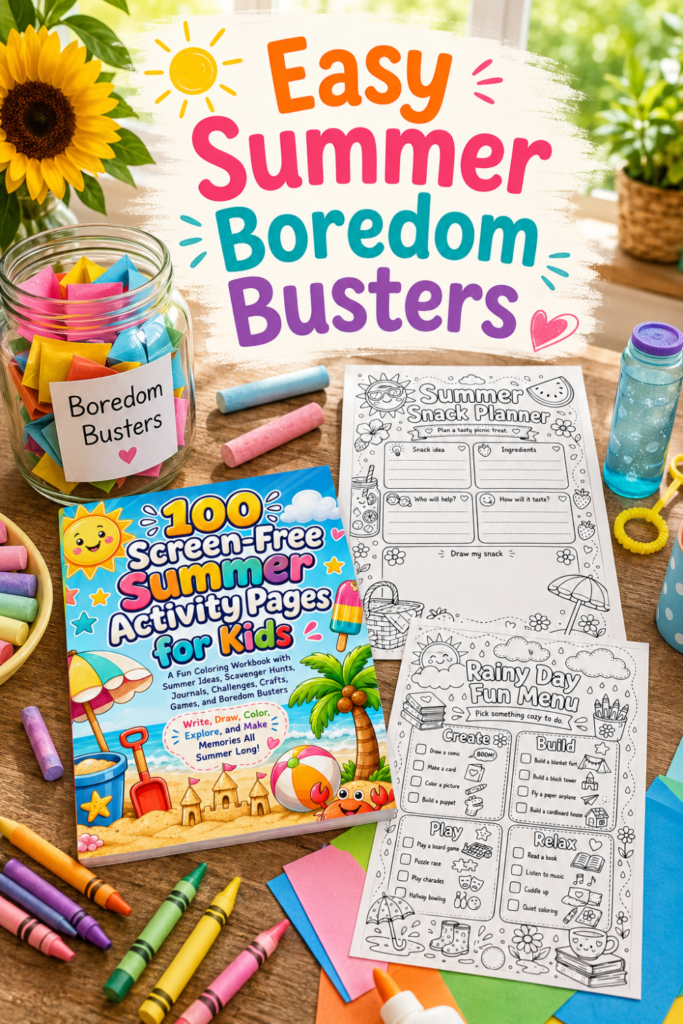
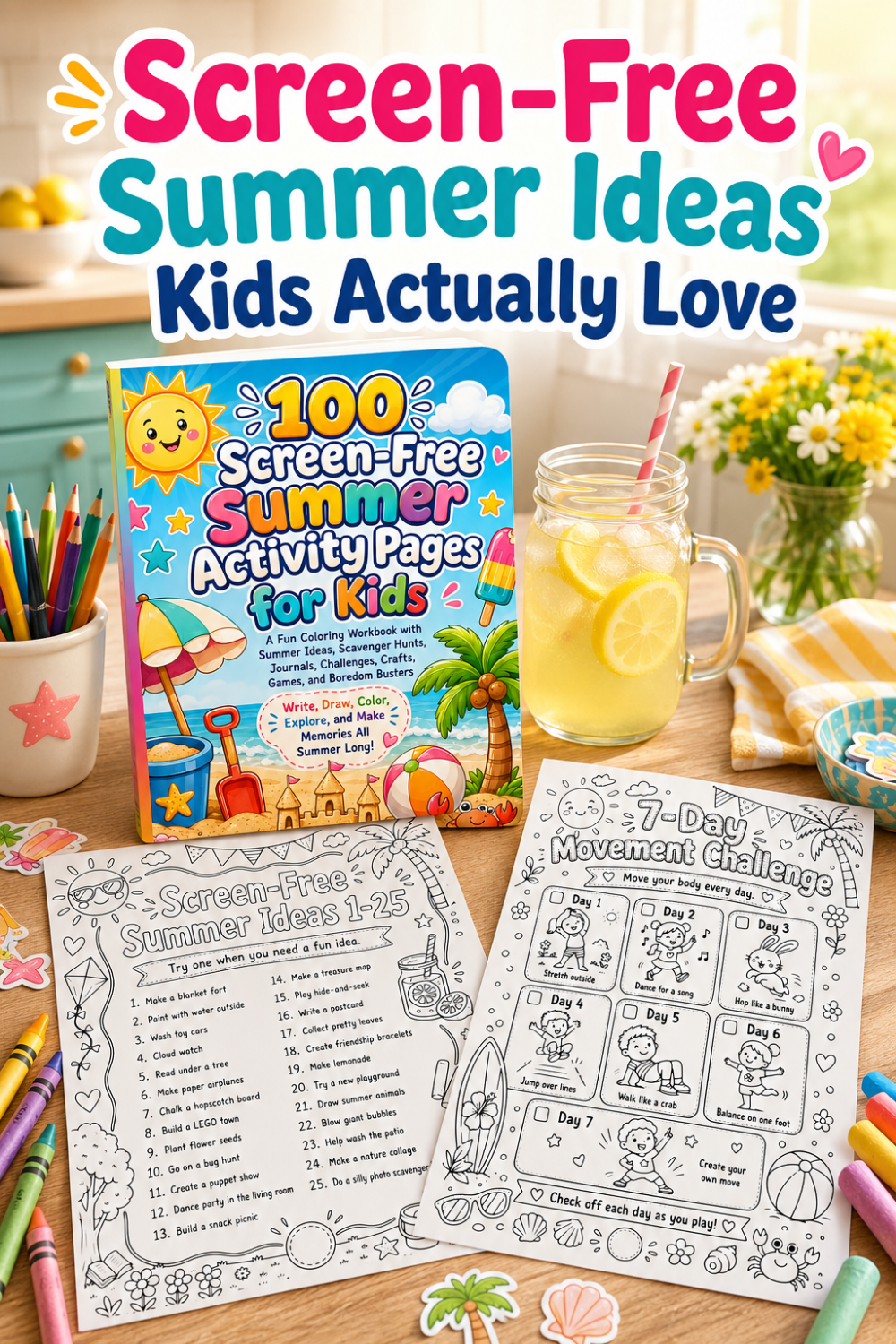
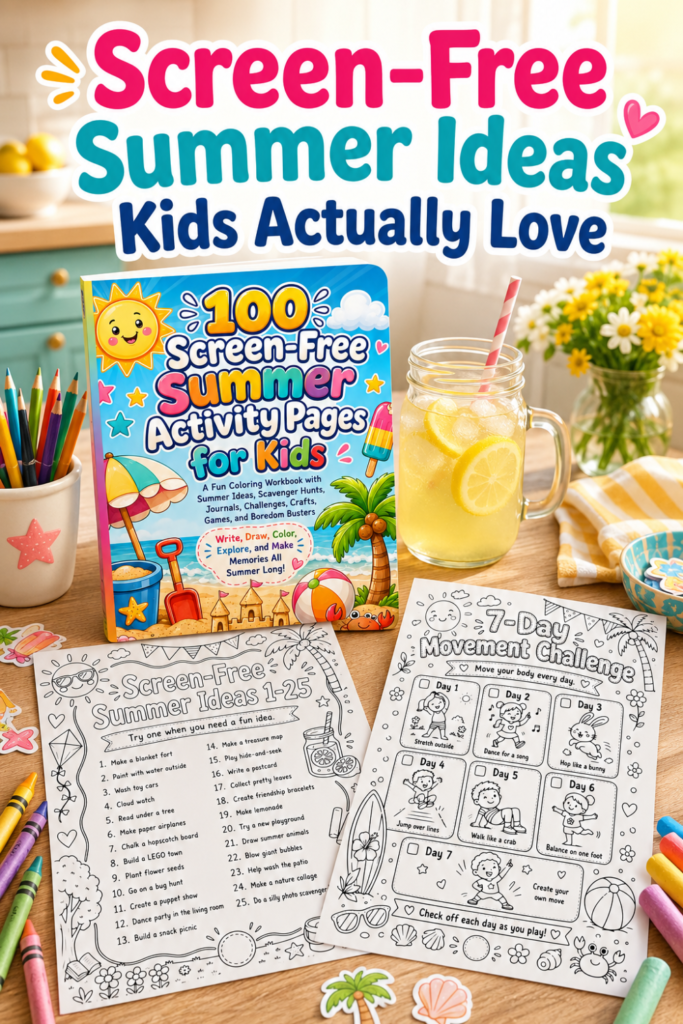
A workbook like 100 Screen-Free Summer Activity Pages for Kids: Coloring Workbook with Summer Ideas, Scavenger Hunts, Journals, Challenges, Crafts, Games, and Boredom Busters is such a great example of what I mean. It is not just a coloring book. It is not just a journal. It has coloring pages, scavenger hunts, journal prompts, bucket list pages, daily planners, craft planning pages, nature trackers, kindness challenges, and themed boredom buster pages all living together in one place.
That variety matters so much because kids are genuinely not in the same mood every single day.
One morning your child might want to color a cheerful beach scene while you reset the kitchen. Another afternoon they may want to fill out a summer bucket list or plan a pretend lemonade stand. On a rainy day, they might need an indoor boredom buster page. On a warm sunny afternoon, a scavenger hunt page might be just enough to get them outside and curious about the world around them.
When your child wanders in and says “I’m bored,” you can say “Go pick something from your summer basket.”
That one single sentence can save an entire morning.
Have a Plan Before the Boredom Hits
The hardest time to solve boredom is when your child is already deep inside it.
By the time they are dramatically flopped over the couch announcing that there is absolutely nothing to do anywhere in the entire universe, they are not in a great headspace for a reasonable conversation. They want the feeling to stop, and they want it stopped now.
And of course, you are usually in the middle of something when this happens.
Trying to start dinner. Switching a load of laundry. Answering an important message. Unloading groceries while someone asks if you got the good snacks, which apparently means a specific snack that was not on your list.
That is exactly why making a small, simple plan in the morning can change the entire energy of the day.
Before things get away from you, give your kids a few clear choices. “Today when you feel bored, you can choose outdoor play, coloring, a scavenger hunt, quiet reading, or something from your summer workbook.” Kids genuinely do better with a short list of choices than with open-ended, figure-it-out-yourself freedom.
“Go find something to do” can feel paralyzing when you are seven years old.
“Pick one of these three things” feels completely doable.
A boredom jar is another simple idea that works really well and takes about five minutes to put together. Fill a small jar with slips of paper that each have one easy activity on them. “Draw your dream ice cream shop.” “Find five things outside that are green.” “Make a card for someone who might love one.” “Build a pillow fort in the living room.” “Color one page from your summer book.” “Write about your favorite summer snack.” “Invent a new game using only stuffed animals.”
The ideas do not need to be fancy or elaborate. In fact, simpler is genuinely better. The more complicated the options are, the less likely anyone is to actually use them when things get hard.
Screen-free summer success is almost always built on small, repeatable habits rather than big dramatic plans.
A basket. A workbook. A jar full of ideas. A few outdoor missions. A quiet time rhythm that happens most days.
That is honestly enough.
Use Scavenger Hunts to Turn Ordinary Days Into Adventures
There is something genuinely magical about giving a child a mission.
If you say “Go outside and play,” they may groan and immediately come back inside.
If you say “Go see if you can find something shaped like a heart, something yellow, and something that smells like summer,” suddenly they are explorers on a quest.
Scavenger hunts are one of the easiest and most effective screen-free summer activities for kids because you can do them absolutely anywhere. In the backyard. At the park. On a neighborhood walk. At Grandma’s house. Inside the house on a rainy afternoon. Even in the grocery store when you need small minds occupied while you actually shop.
For younger kids, keep scavenger hunts visual and beautifully simple. Colors, shapes, bugs, rocks, flowers, leaves, clouds, shadows, and backyard toys all make wonderful targets.
For older kids, make it a little more thoughtful. Ask them to find something that reminds them of summer, something that makes a sound when you touch it, something that could become part of a story, or something they have genuinely never stopped to notice before.
Scavenger hunts help kids slow down and pay attention to details that adults are usually too rushed to ever see. A trail of ants moving in a perfect line. A feather near the driveway. A cloud that looks exactly like a whale. A rock with a pale stripe running through the center. A flower that was not blooming at all yesterday but is wide open this morning.
That kind of noticing is such a precious and irreplaceable part of childhood.
If your summer workbook already has scavenger hunt pages inside, even better. You can hand your child a pencil, open to the page, and let them go. It feels like a real, purposeful activity without requiring any setup from you at all. The workbook I keep in our summer basket, 100 Screen-Free Summer Activity Pages for Kids, has both outdoor and indoor scavenger hunt pages, which means it works just as well on a blazing hot afternoon when everyone needs a mission as it does on a rainy day when no one can go outside.
For kids ages 4 to 10, there is something deeply satisfying about completing a page and checking things off. Drawing what they found and proudly showing you the finished result gives them a little burst of genuine pride.
Summer needs more of that. More small moments where kids feel curious and capable.
Bring Back the Cozy Magic of Coloring
Coloring seems almost too simple to mention, which is probably exactly why we forget how genuinely powerful it can be.
But there is a reason kids keep coming back to it no matter what else is available.
Coloring gives children a place to focus without pressure. It lets them make creative choices in a completely low-stakes environment. It slows their hands and their minds down at the same time. It invites creativity without requiring any setup, any planning, or any adult management.
A coloring page at the kitchen table can become one of the most peaceful pockets in an otherwise loud summer day.
One child will carefully stay inside every single line. Another will turn the sun purple and the ocean bright orange. Another will scribble joyfully and then proudly announce that they made “a storm at the beach.” All of it is good. All of it counts.
Especially during summer, themed coloring pages can feel extra special and festive. Suns, sandcastles, crabs, popsicles, ice cream cones, beach scenes, lemonade stands, flowers, butterflies, and cheerful summer animals all help make the season feel joyful and worth celebrating.
That is one of the reasons I love having a summer coloring workbook nearby and ready to go. The one we use has the most adorable kawaii-style illustrations, and my kids genuinely light up flipping through the pages choosing which one they want to do next. Beach crabs with big eyes, smiling ice cream scoops, little sandcastles, sunshine characters. It gives kids a creative activity that is always prepared and waiting. No printer needed. No searching for files online. No “where did I save that” moment at the worst possible time.
Just open the book, pick a page, and start.
Coloring also fits beautifully into a daily summer rhythm. Maybe your child colors after breakfast while you reset the kitchen. Maybe it becomes the quiet time activity after lunch that gives everyone a midday reset. Maybe it appears during the late afternoon slump when everyone is a little tired, a little sticky, and a little too close to a meltdown.
You can make it feel extra special with almost no effort at all. Put on some calm music in the background. Pour lemonade into cups. Set out crayons in a pretty bowl. Let the kids color on the porch, at the kitchen table, or spread out on a blanket in the living room.
The activity is simple. But the feeling can be one of the things they actually remember.
Sometimes what kids hold onto most is not that you planned something elaborate or Pinterest-worthy. It is that one afternoon everyone sat together coloring ice cream cones while the windows were open and the whole house smelled like sunscreen and summer.
Add Summer Journaling Without Making It Feel Like School
The word “journal” can make some kids immediately narrow their eyes and cross their arms, because it sounds exactly like schoolwork.
The trick is keeping summer journaling gentle, creative, and completely pressure-free.
A summer journal does not have to be a polished daily diary. It does not need full, perfect sentences every single day. It does not need to be corrected, graded, or turned into any kind of lesson.
It can be as simple as drawing the best thing that happened today. Writing three words about the weather outside. Creating a pretend postcard from an imaginary beach vacation. Listing every single favorite summer snack in order. Designing a dream treehouse room by room. Drawing a bug they spotted on the sidewalk.
For younger kids, journaling may look almost entirely like drawing. That is completely wonderful. Drawing is storytelling, and storytelling is everything.
For older kids, simple prompts can help them express themselves in a way that feels natural rather than assigned. They might write about something brave they tried this week, a place they really want to visit someday, a funny family moment they do not want to forget, or one summer memory they want to keep forever.
A workbook with guided journal prompts and open drawing spaces removes the blank-page panic entirely. Instead of staring at an empty white page with no idea where to begin, the child sees “Start right here” and the ideas begin to flow naturally.
Summer journaling also gives kids a gentle way to process their days. Summer is exciting, but it can also feel surprisingly unstructured. Some children absolutely thrive in that kind of freedom. Others feel a little wobbly without the familiar routine of the school year. A few minutes of writing, drawing, or planning can give them something steady to hold onto.
And those pages become something truly precious at the end of the summer. Little snapshots of exactly who your child was during that particular season. The way they spelled popsicle at that age. The picture they drew of the neighborhood pool. The list of everything they wanted to do before school started again. You cannot recreate those details later, no matter how hard you try.
That is the quiet, lasting beauty of giving kids a place to record their summer while it is still happening.
Build a Summer Bucket List That Does Not Exhaust You
I love a summer bucket list, but I think we have to be really honest about keeping them realistic and kind to ourselves.
A good family summer bucket list should feel inspiring and exciting, not like a second job.
It should not be forty expensive outings, complicated day trips, and activities that require packing the car like you are relocating your entire household across the country.
The best summer bucket lists mix easy, cozy, silly, creative, and genuinely special things together in a way that feels doable.
Have a picnic lunch in the backyard. Make root beer floats on a regular Tuesday. Visit the library and let everyone pick whatever they want. Paint rocks. Run through the sprinkler until someone is soaking. Have a pajama movie night. Build a blanket fort that stays up too long. Watch the sunset from the front porch. Try a brand new playground. Mail an actual letter to someone who will love receiving it. Make homemade ice cream sandwiches. Eat breakfast outside. Go on a nature walk with no destination. Sleep in the living room for one night. Make a kindness card for a neighbor.
Let your kids help make the list. Their ideas might genuinely surprise and delight you.
Sometimes we assume kids are dreaming about big elaborate experiences. Then they ask to eat cereal on the porch or have a “fancy lunch” with paper napkins folded into triangles and lemonade in the nice cups.
A workbook with bucket list pages gives kids a space to dream, plan, and check things off proudly on their own. The 100 Screen-Free Summer Activity Pages workbook has dedicated bucket list pages where kids can write down their big summer dreams AND a separate section to track the ones they actually do. My kids love that part especially because checking something off feels like the best kind of proof that summer was real and good and worth paying attention to. They feel genuinely involved in the summer rather than just being carried along by whatever mom decides each day. And when boredom shows up, you can say “Let’s pick one thing off your list today.” That feels so much calmer than scrambling for an idea while everyone is already feeling difficult.
The goal is never to complete every single item on the list.
The goal is simply to create moments.
The list is just a gentle, loving invitation to try.
Create a Quiet Time That Gives Everyone a Reset
Summer days can get loud surprisingly fast.
Sibling disagreements. Neighborhood noise spilling in through every window. Doors opening and closing on repeat. Someone asking where their goggles are for the fourth time. Someone else in tears because their popsicle broke in half at the stick. The constant full-volume soundtrack of kids being home together all day long.
Even on the very best days, it is genuinely a lot.
That is exactly why quiet time matters. Not just for kids. For moms too, maybe especially for moms.
Quiet time does not require naps, particularly once kids outgrow them. You can call it creative time, reading time, rest time, or independent time. Whatever name works naturally for your family.
The key is making it predictable and consistent. Maybe after lunch every day, everyone finds a quiet activity for 30 to 45 minutes. They can read, color, draw, work on a puzzle, listen to an audiobook, or open their summer activity workbook to any page that catches their eye.
At first, there may be some resistance. If kids are used to constant stimulation and entertainment, quiet time can feel genuinely uncomfortable in the beginning. But over time, it often becomes one of the most peaceful and anticipated parts of the whole day.
The trick is to keep the choices specific and clear rather than wide open. “Do whatever you want” tends to quickly become couch jumping or sibling arguments. Instead, try “During quiet time, you can choose books, coloring, your summer workbook, or puzzles.”
A workbook is especially helpful here because it gives a child many different calm options all contained in one place. They can color a summer page, fill out a journal prompt, work through a planner, try a simple challenge, or complete a themed activity page, all completely independently and without needing you to manage or orchestrate any of it.
Quiet time is not about forcing kids into perfect silence on command.
It is about giving everyone a small, gentle reset. A little breathing room before the rest of the afternoon unfolds.
Get Kids Outside With Simple Tiny Invitations
We do not need a big fancy backyard or a collection of expensive outdoor equipment to make outside time work.
Simple, specific invitations are often all it actually takes.
Give a child a bucket and ask them to collect interesting rocks from the yard. Hand them sidewalk chalk and invite them to draw an entire zoo, a restaurant, a race track, or a hopscotch path with special rules. Give them a paintbrush and a bowl of water and let them “paint” the fence or the sidewalk. Ask them to build a tiny fairy house using only leaves and sticks they find. Send them outside to find one thing for every color of the rainbow.
Outdoor play becomes so much easier when you give kids a tiny specific direction instead of one vague, open command.
“Go outside” can feel completely pointless to a child.
“Go make a nature restaurant with leaves, sticks, and rocks” feels like the very beginning of a story.
Kids love stories. They love missions. They love the feeling of being on an adventure, even a small one in their own backyard.
A summer workbook with nature tracker pages and outdoor observation prompts can make this even more special. Kids can check off the weather, draw the clouds they see, notice birds, track flowers changing week by week, or write down everything they discover on a short walk. It turns an ordinary backyard afternoon into something that feels purposeful and worth remembering.
This is particularly helpful for kids who insist they do not like being outside. Sometimes all they need is a reason to get started.
Rescue Rainy Days With a Cozy Indoor Plan
Rainy summer days tend to go one of two ways in our houses.
They become long, restless days of screens and pent-up energy bouncing off every wall. Or they become cozy little memory days that kids actually bring up later and smile about.
Not perfect, of course. Rainy summer days still come with muddy shoes tracked across the floor, damp towels draped over everything, and children pressing their faces against windows like small, very bored house cats.
But with a few simple ideas ready and waiting, rainy days can feel genuinely special rather than something to just survive.
A simple rainy day basket filled with coloring pages, stickers, puzzles, a few craft supplies, books, card games, and a summer activity workbook can completely transform the energy of a stuck-inside day. Add a snack that feels a little fun and festive, like popcorn, fruit skewers, crackers with cheese, or a bowl of homemade trail mix, and you have something that feels almost like a planned event.
Then lean into the cozy instead of fighting against it.
Let the kids build the best fort they can manage. Spread a big blanket on the living room floor. Put on soft background music. Make a pretend indoor picnic with a checkered dish towel. Pull out crayons and let everyone choose a page to color while you sit nearby. Invite them to write or draw their idea of the perfect rainy day. Let them plan an imaginary lemonade stand, a pretend camping trip, or a backyard adventure to have when the sun comes back. One of my favorite pages in the 100 Screen-Free Summer Activity Pages workbook is literally called the Rainy Day Fun Planner, and it is perfect for exactly this. Kids fill it out, pick their cozy activities, and suddenly a stuck-inside day has a shape and a purpose instead of feeling like something that just happened to them.
Rainy days are also surprisingly wonderful for kindness activities. Kids can make cards for neighbors, write notes to grandparents, draw pictures for friends, or brainstorm one kind thing they want to do for someone in the family before the day is over.
Screen-free summer is not only about keeping kids occupied. It is also about helping them slow down, notice the people around them, and feel connected to something beyond a glowing screen.
Rainy days are often the very best days for that quiet kind of connection.
Keep Screen-Free Options Ready for Car Trips
Summer almost always means more time in the car.
Road trips, family vacations, library runs, grocery store trips, appointments, visits to family, and those mysterious errands that always take twice as long when small children are involved.
Screens can feel like the path of least resistance for long drives, and sometimes they genuinely are part of the plan. That is okay.
But having a few screen-free car activities ready makes a real, noticeable difference.
A summer activity workbook is perfect for travel because it is completely portable and entirely self-contained. Pair it with a small pencil pouch of crayons or colored pencils and you have an activity that requires absolutely no Wi-Fi, no charging cords, and no volume negotiations between the back seat passengers.
Kids can color, write in journal pages, fill out planners, play simple pencil games, or work through activity pages while riding along or waiting at a restaurant.
Car scavenger hunts are another favorite. Look for a red truck, a dog, a stop sign with graffiti on it, a water tower, a yellow flower, a bicycle leaning against something, a flag waving, or a cloud shaped like something surprising and funny.
The real key to screen-free car success is having everything packed and ready before you leave home. When there is no plan ready, the tablet always becomes the plan by default. A small pre-packed activity bag with the workbook, crayons, a water bottle, and a snack or two means you are not scrambling while someone is already buckled in and restless.
Someone will absolutely still drop a crayon under the seat. Someone will still ask how much longer approximately every six minutes. Someone will need a bathroom five minutes after you pull away from home.
But having a few screen-free tools ready makes the whole ride a little smoother and a little calmer for everyone.
Make Crafts Simple Enough That You Will Actually Say Yes
Crafts can be one of the most wonderful screen-free summer activities, but I think we have to be honest here.
Some craft ideas are clearly invented by people who do not have to clean up the kitchen afterward.
I genuinely love creativity and making things together. But I do not love activities that require twelve specific supplies, hot glue, glitter, something that needs to dry for four hours, and thirty minutes of emotional recovery once it is over.
For summer, simple crafts are the ones that are actually sustainable.
Paper plate suns. Rock painting in the driveway. Simple nature collages. Paper bag puppets. Homemade bookmarks for summer reading. Sticker scenes on blank paper. Sidewalk chalk murals that take over the whole driveway. Friendship cards for their people. Leaf rubbings with crayons and paper. Decorated journals they will actually use.
The simpler a craft is to start and to clean up, the more likely you are to say yes when your child asks. And a yes in that moment matters more than a perfect project.
Craft planning pages can also be surprisingly fun for kids. Before they start making something, they draw their idea first, think through what supplies they need, and imagine the steps. This genuinely helps them feel more independent, and it cuts down on the “Mom, I need…” spiral where you become the one running around finding tape and markers for the next twenty minutes. The summer activity workbook I recommend actually has craft project planner pages built right in, so kids can sketch their idea, make their supply list, and walk through the steps before they ever touch a single glue stick. It is one of those features that sounds small but honestly changes everything about how smoothly the craft goes.
They will always still need tape. But at least they thought about it first.
Add Small Kindness Challenges Into Your Summer
One of the most overlooked and underestimated screen-free summer activities is kindness.
Not in a heavy or formal way. Just small, gentle invitations for kids to think about someone other than themselves for a moment.
Summer can gradually become very me-focused for kids. What are we doing today. Where are we going. Can I have a snack. Can I have a turn. Can I watch something? That is completely normal and honestly just childhood.
But small kindness activities can shift the energy of a day in a really sweet, unexpected way.
Ask your child to draw a picture for someone they love. Help water the flowers. Write a thank-you card for someone who helped them. Pick up five pieces of litter on an afternoon walk. Write a kind note and leave it somewhere surprising. Call a grandparent who would love to hear a small voice. Share something without being asked. Make a “you are loved” sign and tape it somewhere in the house.
These small acts help kids feel genuinely useful and connected to the people around them. A kindness planner or challenge page in a workbook makes it feel exciting rather than assigned. They get to choose one kind thing to do that day and then draw or write about how it went afterward. The 100 Screen-Free Summer Activity Pages workbook has kindness planner pages that are gentle and sweet without feeling preachy, which I love. Kids pick an act of kindness, plan it out a little, and then have a space to reflect on it. It is a tiny habit that quietly builds something really important inside a child over a whole summer of practice.
Those moments end up being some of the most encouraging parts of summer for moms too. Watching your child proudly deliver a drawing or help without being asked reminds you that something genuinely good is quietly growing underneath all the noise and snack requests.
Let Kids Help Plan Their Own Summer Days
Kids thrive when they have a little bit of real control over their own days.
And summer is a genuinely wonderful, low-pressure season to practice that in small, supported ways.
Simple kid-friendly planning pages help children begin to understand time, routines, choices, and responsibility without making summer feel like an extension of the school year.
A child-friendly daily planning page might have space for the weather, one thing they want to do, one helpful task for the family, one outdoor activity, one creative activity, and one thing they are grateful for that day.
This does not have to be rigid or followed perfectly every single day. Think of it more like a soft, gentle rhythm rather than a schedule with consequences.
Kids can plan a morning activity, pick something for quiet time, or choose one item from their bucket list to try that week. They can help decide whether today feels more like a coloring day, a backyard day, a craft day, or a library day.
When kids help create the plan, they are genuinely more excited to participate in it. And for you, it quietly takes a small piece of the mental load away. Instead of being the only person responsible for filling every summer day with ideas and energy, you are inviting your child into the process alongside you.
A workbook with daily and weekly planner pages supports this beautifully. It gives kids a real place to write, draw, and organize their own summer thoughts. One of the things I really love about the 100 Screen-Free Summer Activity Pages workbook is that it includes a 7-Day Summer Kickstart section to help families ease into screen-free summer with a little bit of structure and a Lemonade Stand Planner page that lets kids actually plan out their pretend or real stand from scratch. Those themed planning pages are the ones my kids always go back to, because they feel purposeful in a way that just “writing in a journal” does not always feel to a seven-year-old.
And best of all, it gives you a calm, easy answer to the morning question “What are we doing today?”
You can simply say “Let’s go check your summer planner.”
That feels so much better than making something up while standing at the kitchen counter with no coffee yet.
Create a Screen-Free Summer That Fits Your Actual Real Life
The most important thing to hold onto through all of this is that your screen-free summer does not have to look like anyone else’s.
Some families have big backyards. Some have small apartments. Some have flexible schedules. Some have working parents who are managing meetings and childcare at the same time. Some have babies and big kids under one roof. Some have children who love crafts more than anything. Some have children who would happily dig in the dirt every single day and call it perfect.
There is no one right version of this.
Your screen-free summer can include library days and lazy days. Backyard adventures and living room forts. Coloring pages and sprinkler afternoons. Road trip activities and quiet journaling sessions. A workbook at the kitchen table on a Tuesday and a movie night together on Friday.
Screens do not have to disappear entirely for creativity and imagination to grow back and flourish. You are simply making sure that screens are not the only option your child reaches for every single time.
That is a completely doable goal. Not perfect. Doable.
And doable matters so much more than perfect, because the best summer plans are the ones you can actually return to even after a messy day. Even after everyone watched too much TV yesterday. Even after the craft went sideways. Even after you completely forgot the plan and just survived from one hour to the next.
You can always reset. Tomorrow morning is a fresh start.
Crayons on the table. A scavenger hunt in the yard. A quiet journal page after lunch. A bucket list item checked off before dinner.
Small choices made consistently add up to a whole beautiful summer.
FAQs About Screen-Free Summer Activities for Kids
What are the best screen-free summer activities for kids?
The best options are ones your child can begin on their own without needing a lot of adult help to get started. Coloring, drawing, scavenger hunts, sidewalk chalk, nature walks, simple crafts, journaling, puzzles, reading, blanket forts, water play, and summer activity workbooks are all really excellent choices. For kids ages 4 to 10, variety is especially helpful because their moods and attention spans genuinely shift from day to day. Having a mix of creative, outdoor, quiet, and movement-based activities makes screen-free time feel easier and more natural for everyone.
How do I get my kids to stop asking for screens all day long?
Start by creating a predictable rhythm rather than reacting in the moment to every screen request as it comes. For example, mornings might be for outdoor play or creative activities, afternoons have a quiet time period, and screens only happen at a specific time if you choose to include them. It also helps enormously to make other options visible and easy to access. A summer activity basket, a boredom jar full of ideas, and a screen-free workbook give kids something immediate to reach for when they feel bored. The goal is not to lecture them out of wanting screens. The goal is to make other choices easier and more natural.
What can I give my child during quiet time if they have outgrown naps?
Quiet time works best when the choices are calm and specific. Books, puzzles, coloring pages, drawing prompts, stickers, journals, and summer activity workbooks all work beautifully. A workbook is particularly nice because it keeps many different activities in one place. A child can color one day, write or draw the next, try a scavenger hunt page another afternoon, or work through a summer challenge. It always feels fresh without requiring you to set up something new every single day.
Does a screen-free summer mean absolutely zero screens?
Not necessarily, and honestly, not for most real families. A screen-free summer typically means being more intentional about when and how screens fit into the day rather than eliminating them entirely. Maybe screens happen after outdoor play or after quiet time. Maybe you do screen-free mornings or screen-free weekdays with a family movie on Friday night. The point is not to create guilt or set an impossible standard. The point is to make sure kids also have plenty of time to play, create, move, imagine, and connect with each other. A balanced summer can absolutely include both a Friday night movie and a Wednesday morning backyard scavenger hunt. It truly does not have to be all or nothing.
Are summer activity workbooks good for screen-free time?
Yes, especially for kids who need just a small amount of structure to get started on their own. A good summer activity workbook works beautifully for quiet time, road trips, rainy days, vacation days, restaurant waits, and all those everyday “I’m bored” moments throughout the summer. Look for one that includes real variety: coloring, journaling, scavenger hunts, planners, craft planning prompts, games, kindness challenges, and outdoor activity ideas. The more variety it has, the more your child will actually return to it throughout the whole summer rather than leaving it on a shelf after one week. The workbook I recommend and keep in our own summer basket is 100 Screen-Free Summer Activity Pages for Kids, and what I love most about it is that it has 100 pages of genuinely different activities, so there is always something that matches whatever mood your child is in on a given day. It also fits easily in a bag for road trips, which is a huge practical bonus for our family.
Final Thoughts: The Best Summer Memories Are Usually the Simple Ones
When I think about the kind of summer I actually want for my kids, it is not color-coded or perfectly curated.
It is crayons rolling across the kitchen table and nobody picking them up right away. Wet footprints tracked across the back porch. A child proudly carrying over their finished scavenger hunt page to show me every single thing they found. Popsicle drips on the front steps in the late afternoon. A summer journal filled with wobbly, beautiful handwriting and earnest little drawings. A blanket fort that stays up three days longer than it should. A backyard mission that turns into an entire imaginary world that keeps going for hours.
That is the kind of summer that actually stays with kids.
And we do not have to manufacture magic every single minute of every single day. We just have to leave enough room for it to find us.
Enough space between shows. Enough quiet between errands. Enough breathing room in the slow afternoon hours.
Screen-free summer activities are not about being the perfect mom or the most creative mom or the mom with the best Instagram summer. They are about giving our kids real, regular chances to discover what their own imagination actually feels like when they let it run.
So make the basket. Keep the crayons somewhere they can reach. Put the workbook where small hands can find it without asking. Send them outside with one tiny mission. Let them feel bored for a few minutes without rushing to fix it. Let them color the sun pink. Let them call three wobbly sentences a full journal entry. Let them make a gorgeous mess sometimes.
And when the day does not go as planned, because it absolutely will not go as planned regularly, you can simply begin again.
That is one of the best gifts of summer.
Every single morning is a fresh, clean, hopeful page.