The Low-Stimulation Parenting Guide: Reducing Sensory Overload at Home
By a mom who’s been there, sitting in the chaos, wondering why everyone was falling apart.
This post may contain affiliate links, which means I may earn a small commission if you make a purchase through my links, at no extra cost to you. I only recommend products I genuinely believe in and that have made a real difference in our family’s life.
Simple Products That Make a Real Difference
I want to bring it back to practical, because that’s what you came for. Here are the categories of items that come up most consistently when families work toward a lower-stimulation home, and where your affiliate links will feel genuinely helpful rather than salesy, because these are real things that make a real difference.
For sleep and bedrooms: blackout curtains are maybe the single highest-impact purchase a family can make for sleep quality. A quality white noise machine. A Hatch Rest for older babies and toddlers that allows gradual light dimming as part of the bedtime routine. A children’s weighted blanket for children who have a hard time settling.
For calm sensory play: a quality playdough set, woodenopen-ended toys and blocks, kinetic sand, asensory bin with natural materials, a play tent or canopy for a quiet corner.
For the living room: a simple lamp with a warm-toned bulb for evening reading. A basket for device-free time. A beautiful set of books for family reading.
For sensory-sensitive children: seamless socks and tagless clothing, children’s noise-canceling headphones, a small weighted stuffed animal, chewable sensory jewelry.
For evening wind-down: a Himalayan salt lamp in warm amber, a simple essential oil diffuser with lavender (lavender is genuinely one of the most studied and supported calming scents for both children and adults), a sunrise alarm clock for gentle morning waking.
I want to start by telling you something I didn’t expect to say out loud for a long time.
There was a Tuesday afternoon last fall when my daughter was melting down over something so small I can’t even remember what it was, my son was playing a video game with the volume up too loud, the TV in the other room was still going from lunch, my phone kept buzzing with school notifications, the dog was barking at the wind, something was burning faintly on the stove, and I just sat down on the kitchen floor and started to cry.
Not because I was a bad mom. Not because my kids were bad kids. But because I looked around at the noise and the light and the movement and the constant, relentless input of it all and I thought: this is too much. For all of us.
If you’ve ever felt that way, I wrote this for you. This is not a post about being a perfect parent or creating a Pinterest-worthy calm home. This is a real, honest, detailed conversation about something that more and more moms are quietly searching for answers about: sensory overload in our homes and what we can actually do about it.
What Is Sensory Overload, Really?
Before we talk about solutions, I want to make sure we’re talking about the same thing, because “sensory overload” gets thrown around a lot and it means different things to different people.
Our nervous systems take in information from the world through our senses. Sight, sound, touch, smell, taste, and also two that don’t get talked about as much: proprioception (the sense of where our body is in space) and interoception (the sense of what’s happening inside our body, like hunger or heartbeat). Every single moment of every single day, your child’s brain is receiving and processing thousands of tiny signals from all of these channels at once.
For most of human history, the environment controlled how much input came in. Kids played outside in natural light. Meals were quiet or punctuated by one conversation at a time. There was no background noise machine running 24 hours. Evenings got dark and quiet. The nervous system had natural rhythms of stimulation and rest built into the day.
Now think about what a typical modern home looks like.
The TV is on, not because anyone is watching it, but because someone turned it on this morning and no one turned it off. The overhead lights are fluorescent or bright white LED. There are notifications going off on three different devices. The playroom looks like a toy store exploded in it. There are apps, tablets, YouTube, background music, smart home devices that talk back, notifications, timers, alerts. Dinner is eaten while someone has a screen open. Bedtime involves one more show and a glowing nightlight and maybe a white noise machine and by that point everyone’s nervous system has been running at full speed for sixteen hours straight.
None of this is your fault. This is the world we live in. But your child’s nervous system was not designed for it, and neither was yours.
Sensory overload happens when the amount of stimulation coming in exceeds what the nervous system can comfortably process. And here’s the part that matters most for us as parents: you don’t have to have sensory processing disorder or autism or ADHD for this to affect you. It affects all of us. It affects every child. The threshold is just different for everyone.
How Bad Is It, Really? (The Answer Might Surprise You)
I want to be honest with you because I think sometimes we read things like this and nod along and then go right back to life as usual, because it doesn’t feel that urgent. So let me tell you what chronic overstimulation actually does, because it’s more serious than most of us realize.
When a child’s (or adult’s) nervous system is overwhelmed, the body goes into a low-level stress response. Cortisol and adrenaline stay elevated. The brain stays in a mild fight-or-flight mode even when there’s no actual danger. Over time, this wears on the body. Kids who are chronically overstimulated have a harder time regulating their emotions. They’re more prone to meltdowns, tantrums, and explosive reactions to small things. They have more trouble falling asleep and staying asleep. They struggle to focus and learn. Their immune systems are actually impacted by chronic low-grade stress.
For babies and toddlers, it’s even more significant because their nervous systems are still literally developing. What they experience in these early years shapes how their brains wire up. Babies who are chronically overstimulated show signs of dysregulation that can follow them into childhood. They have a harder time self-soothing. They wake more at night. They’re fussier during the day.
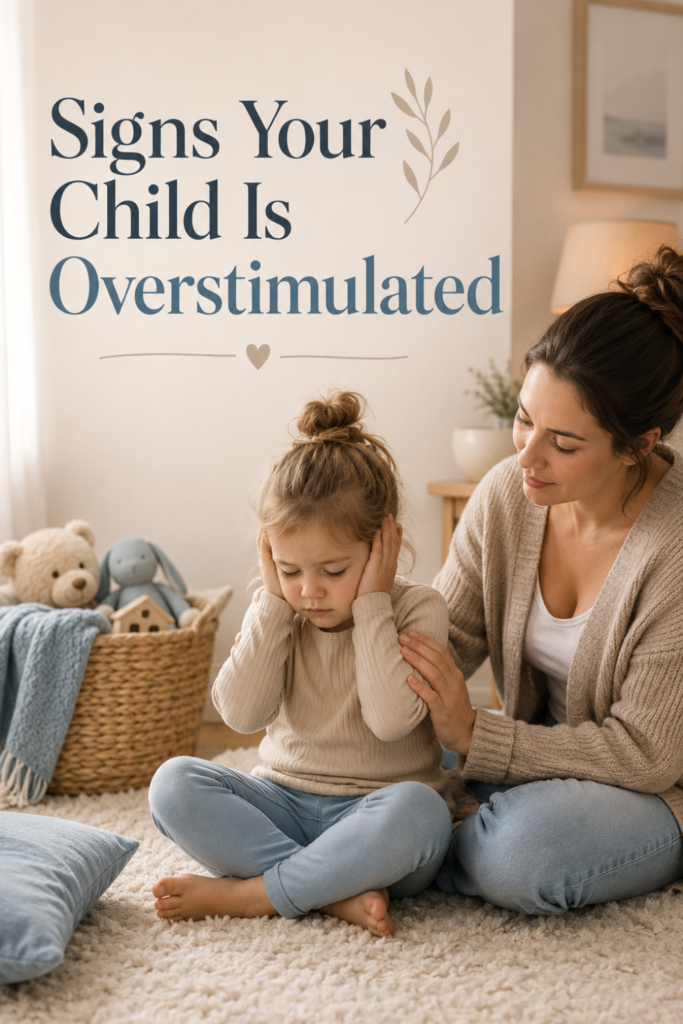
For older kids, it often looks like what we label as “behavioral problems.” The kid who can’t sit still at the dinner table. The one who cries over everything. The one who gets home from school and immediately explodes. The one who can’t wind down at bedtime no matter how tired they are. So often, what looks like a behavior problem is actually a nervous system that has been maxed out all day and has nothing left.
And for us moms? Chronic overstimulation contributes to anxiety, irritability, difficulty sleeping, trouble concentrating, emotional depletion, and what so many of us call “touched out” at the end of the day. That feeling of desperately needing five minutes where no one is touching you and nothing is making noise? That’s your nervous system talking.
The good news, the real honest-to-goodness good news, is that the nervous system is remarkably adaptable. Small, consistent changes to the sensory environment can make a profound difference. You don’t have to overhaul your entire life. You just have to start noticing.
The First Step: Learning to See Your Home Differently
One of the most powerful things I ever did was walk through my own house with fresh eyes. Not my mom eyes that had learned to tune everything out. Really look. Really listen. Really feel.
I want you to try this. Pick a time when the house is doing its normal thing, everyone’s home, the usual chaos is happening. Stand in the middle of your main living space and close your eyes for thirty seconds. Just listen. How many sounds can you identify? The TV, a tablet, music, the fridge humming, outdoor noise coming through a window, someone’s toy, a notification sound, someone talking, the HVAC? Open your eyes. How many light sources are on? How cluttered does the visual field feel? How many things are on the counter, on the floor, on every surface?
Now imagine you are three years old and your nervous system is still learning to filter all of this out. Or imagine you are a child who has already been at school for seven hours taking in stimulation at that level. Or a baby who has never experienced anything before. This is the exercise that changed things for me. Not guilt. Just seeing.
Once you start seeing your home through this lens, you’ll start noticing patterns. You might realize the afternoons are always hardest and also happen to coincide with when everyone’s been in the noisy, bright kitchen. You might notice your toddler’s meltdowns almost always happen after a long car ride with music on. You might notice your own mood shifts depending on whether the living room is tidy or chaotic. These are not coincidences. These are your family’s nervous systems giving you information.
Sound: The Invisible Noise We’ve Stopped Hearing
Sound is often the biggest culprit and the one we’re most blind to because we tune it out so completely. Let’s talk about it honestly.
Background television is probably the single most overstimulating thing in most American homes, and it’s also the most normalized. A TV on in the background is not neutral. The sound is designed to capture and hold attention. The rapid editing and changing tones are processed by the nervous system even when we don’t think we’re watching. For young children especially, background TV has been studied extensively and found to disrupt play, reduce parent-child verbal interaction, and contribute to attention difficulties over time.
This doesn’t mean no TV ever. It means intentional TV. You sit down to watch something specific, and then it goes off. It’s a small shift in habit that makes an enormous difference in the sensory atmosphere of the home.
Music is similar. I love having music on, I really do. But I’ve learned that there’s a difference between music I’ve consciously chosen to listen to and music that’s just filling space because silence feels uncomfortable. Silence, it turns out, is actually deeply restorative for the nervous system. Many of us have become so accustomed to constant sound that silence feels wrong. But for our kids’ developing brains and for our own depleted ones, quiet is genuinely nourishing.
If you do want sound in your home, softer and slower is almost always better. Classical music, acoustic guitar, soft instrumental playlists. There are actually playlists designed specifically for nervous system regulation, and they’re wonderful. A small Bluetooth speaker on a bookshelf playing something gentle is so different from a TV blaring in the corner.
One product that has genuinely made a difference in our home is a simple white noise machine for the kids’ rooms. Not for stimulation but as a buffer against the household noise that seeps under doors during wake windows and nap times. Something like the LectroFan Classic or the Hatch Rest has been a game changer for so many families I know, and it’s a natural place to include your affiliate link for mamas who are ready to make a change right away.
Notifications are worth their own mention. The average smartphone user receives dozens of notifications per day. Each one produces a small spike of cortisol. In a house full of devices, the cumulative sound of pings and chimes and buzzes adds up to a constant low-grade alert state. Turning notifications to silent or do not disturb during family time is free and immediate.
Light: What We’ve Done to Our Evenings
Our bodies, and our children’s bodies, are regulated by light in ways that are ancient and deeply wired. Natural light cycles tell our brains when to be alert and when to wind down. Melatonin production, the hormone that makes us sleepy, is triggered by darkness and suppressed by light, especially blue-spectrum light.
The lights in most modern homes are the opposite of what our nervous systems need, especially in the evenings.
Overhead lighting is activating. Bright white or cool-toned LEDs are particularly stimulating because they’re rich in blue light. Having bright overhead lights blazing at 7pm is telling every nervous system in your house “it is daytime, stay alert.” Then we wonder why the kids won’t settle down at bedtime and why we can’t fall asleep after scrolling our phones.
One of the most impactful and honestly underrated changes you can make is to switch to warm, dim lighting in the evenings. This means replacing some overhead bulbs with warm-toned options (look for bulbs in the 2700K range or lower), getting a few floor lamps or table lamps with warm shades, and dimming the lights starting about two hours before bedtime.
I love recommending a Himalayan salt lamp for kids’ rooms and reading corners. They put out a beautiful warm amber glow that is genuinely calming and many kids love them. They’re also practical nightlights for middle-of-the-night bathroom trips without being activating. This is a wonderful, low-cost item to link to on Amazon because it’s useful, beautiful, and makes a real difference.
For the kids themselves, limiting screen time in the two hours before bed is science-backed and important, but I know it’s also hard. If screens happen in the evening (and in real life, sometimes they do), blue light blocking glasses for kids are an option worth knowing about. They look cute, kids tend to think they’re cool, and they do take some of the edge off.
Visual clutter is also a form of overstimulation that we don’t always think about as “light” but absolutely impacts the nervous system. When a room is crammed with stuff, toys on every surface, clothes on the floor, piles of papers, things shoved in corners, the visual cortex is working constantly to process all of it. This is why so many people feel anxious in a messy room and calmer in a tidy one. It’s not a personality trait. It’s just how brains work.
I’m not saying become a minimalist (though if that calls to you, go for it). I’m saying that reducing visual noise in the main spaces where your family spends time is deeply worth the effort. Which brings me to one of my favorite topics.
Toys: The Hard Conversation
Okay, I want to be gentle here because I know this can feel like criticism and it is not. We buy toys because we love our kids. We want them to have things that delight them and help them learn and grow. There is nothing wrong with that impulse.
But the sheer quantity of toys in most modern homes has crossed a threshold that is working against our kids, not for them.
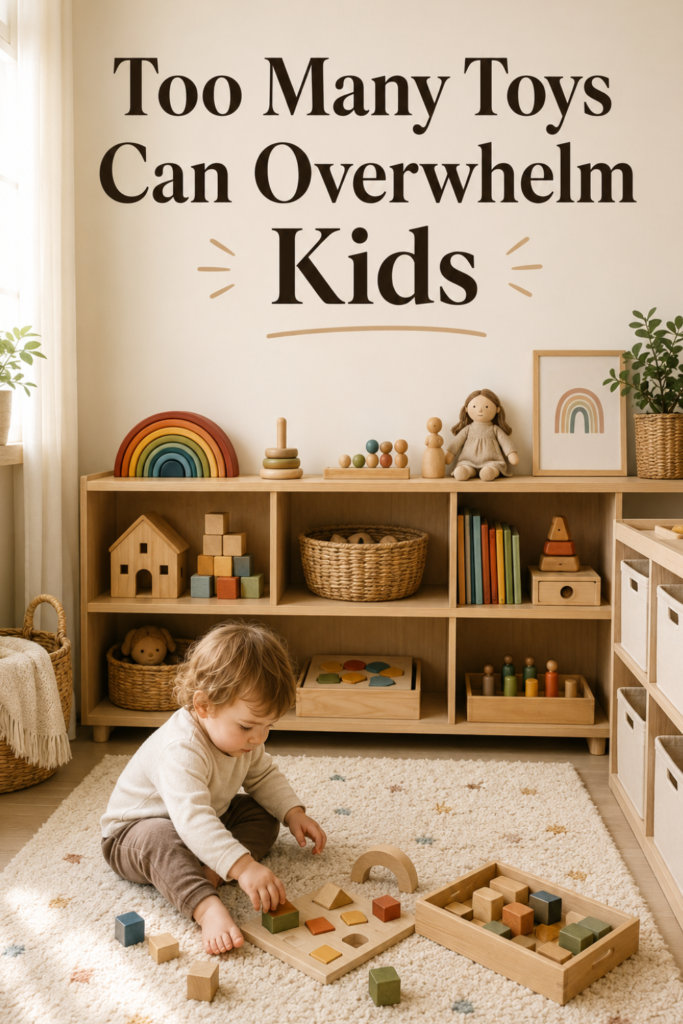
Here’s something fascinating that researchers have found: children actually play more creatively and for longer stretches with fewer toys. When there are too many options, kids cycle through them rapidly, can’t settle into deep play, and end up more restless and harder to manage. The paradox of too much choice is real, and it hits children harder than adults because their developing brains have less capacity to manage overwhelm.
A toy rotation system is one of the most practical and effective things you can do for your home’s sensory environment and your kids’ wellbeing. You pull out about a third of the toys at a time, box up the rest, and rotate them every few weeks. The toys that come out of the box feel new and exciting again. Your playroom is calm and manageable. Your kids play longer and more deeply with what they have.
For the toys that are out, open-ended toys that don’t have lights, sounds, or batteries are almost universally better for calm, creative play. Wooden blocks, LEGO, art supplies, dolls, small figures, playdough, simple puzzles. These invite a child’s imagination to fill in the gaps rather than bombarding their senses. A beautiful wooden toy set on Amazon or a simple set of large building blocks for toddlers are the kinds of things that are genuinely worth linking to because they last forever and serve children for years.
One thing that has helped our family enormously is having a “one toy out at a time” rule for younger kids. You play with what you have out, you put it away, then you choose something else. This is hard to implement and takes some patience at first, but it transforms the chaos level of your home within a week. It also teaches focus and follow-through that serves kids beautifully as they get older.
Screens: Honest, Non-Judgmental, Practical
I am not going to tell you to throw out the screens. I have screens. My kids use screens. You’re probably reading this on a screen right now. The goal is not elimination, it’s intentionality, and there’s a huge, real difference.
The nervous system impact of screens is significant and worth understanding clearly. Fast-moving content, the kind that dominates most children’s YouTube and many popular apps, fires the dopamine system rapidly and repeatedly. This trains the brain to need higher and higher levels of stimulation to feel interested. It also makes slower, quieter activities (like drawing, playing outside, or having a conversation) feel boring by comparison. This is not a moral failing of children who watch too much. It’s just how brains respond to that level of input.
The most protective thing you can do is not necessarily how much screen time but what kind. Slow, narrative-driven shows where a story unfolds and dialogue happens are much gentler on the nervous system than fast-cut content. Shows like Bluey are genuinely beloved by parents who practice low-stimulation parenting because the pacing is calm, the emotional content is rich and real, and children are watching characters who feel, talk, and work through things. Compare that to the average YouTube kids channel and the difference is immediately apparent.
For very young children, the recommendation to avoid screens under two and limit them before three is not arbitrary. It’s rooted in how sensory processing and language development work in those critical windows.
Devices at the dinner table deserve their own firm stance. Mealtime is one of the most naturally regulating rituals a family can have. Real conversation, eye contact, food that engages multiple senses in a good way, the rhythm of a shared experience. Screens at the table disrupt all of that. This might be the single easiest rule to implement with the greatest return: phones away, devices away, just us at the table. Even if it means more awkward silence at first. Especially if it means that.
The Sensory Environment Room by Room
Let me walk you through your home with some specific, practical ideas, because I know sometimes it’s easier to think room by room.
The Kitchen and Dining Area
This is the heartbeat of most homes and often the most chaotic. Keep the counter surfaces as clear as you can manage. The visual calm of a clean counter genuinely affects the mood of everyone who walks in. When you’re cooking, be intentional about sound. Maybe you choose one playlist or podcast you’re actually enjoying, rather than the TV on in the background. If you have young children underfoot, a simple sensory bin at the kitchen table, a container of dried rice and some cups and scoops, gives them focused, satisfying, calming sensory input that is very different from screen input.
The Living Room
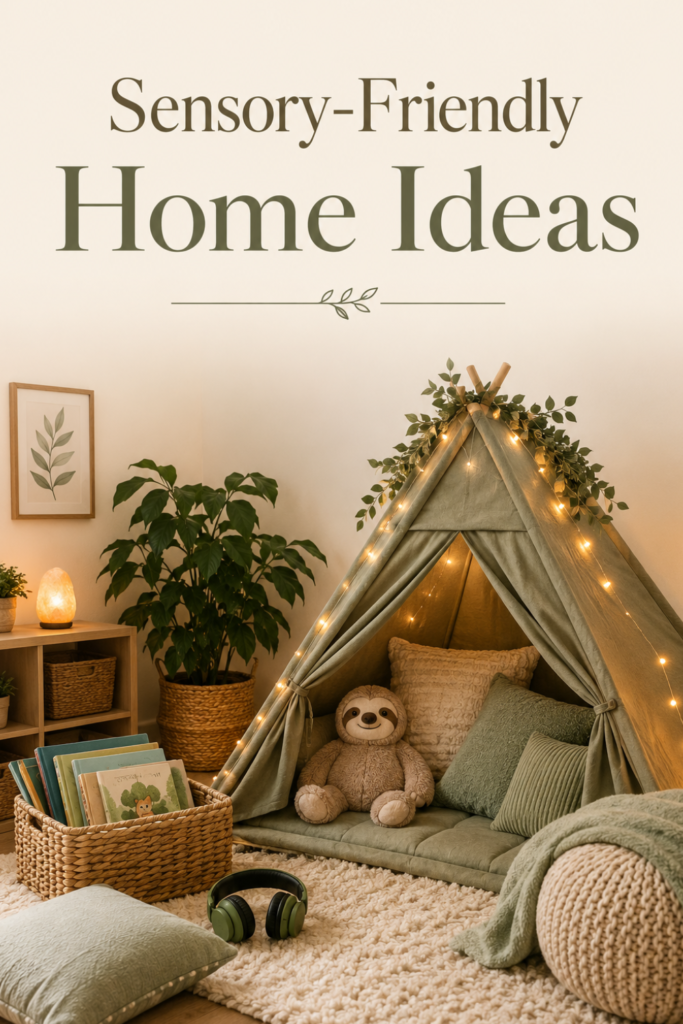
This is where the TV challenge usually lives. Having a basket or bin where remote controls and devices go during non-screen time is a small physical habit that helps the family transition in and out of screen time intentionally. I love a cozy reading corner in the living room, a soft chair or floor cushion, a small lamp, a basket of books. It signals to the nervous system: this is a slow place. A beautiful floor cushion or a reading nook canopy from Amazon can make this feel special for kids without a big renovation.
The Playroom or Play Area
This is where the toy rotation lives, as we discussed. I also want to mention the power of a dedicated quiet corner in the play space. A small tent or teepee, a canopy, even just a cozy reading nook with pillows and soft lighting, gives children a self-directed retreat when they feel overwhelmed. Many children, especially those with sensory sensitivities, instinctively seek these out. A simple play tent on Amazon is one of those purchases that pays off over and over. Some families line theirs with soft fairy lights in warm amber tones and fill it with pillows and a few beloved books.
Sensory tools for the play space are worth knowing about. Fidget toys, weighted stuffed animals, and kinetic sand or playdough are all ways of giving the nervous system the input it craves in a focused, controlled way. A small weighted stuffed animal is particularly wonderful for children who tend to seek heavy input, the ones who crash into furniture, want to be squeezed, or love rough play. That deep pressure meets a nervous system need in a calming rather than escalating way.
Bedrooms
The bedroom should be the most protected space in the house. This means: no screens ideally, or very limited ones. Warm dim lighting in the evening. Blackout curtains (one of the most practical purchases any family can make, for kids of all ages). A white noise machine or soft sound machine. As few toys as possible, because the bedroom is for rest, not stimulation.
For children who have a hard time settling, a simple bedtime routine that is predictable and calming matters more than almost anything else. Predictability regulates the nervous system because the brain isn’t spending energy wondering what comes next. Bath, pajamas, dim lights, a few books, soft voices, goodnight. The same order, every night. It is boring and it is brilliant.
A weighted blanket is something many families find deeply regulating for children who have a hard time settling. The deep pressure of weight helps calm the nervous system in a physical, direct way. There are weighted blankets made specifically for children at various weights and sizes, and the child’s body weight matters in choosing one. Your affiliate link here is genuinely helpful because there are a lot of options out there and a trusted recommendation matters.
For the Mom Who Can’t Do a Big Overhaul
I see you. You’re reading this thinking: this sounds wonderful and also completely impossible in my life right now.
Maybe you’re a single mom. Maybe you’re working full time. Maybe you have a partner who isn’t on board. Maybe you have multiple kids at different ages and the needs feel completely incompatible. Maybe you live in a small space. Maybe money is tight. Maybe your kids would absolutely lose their minds if you took away half their toys tomorrow.
You don’t have to do all of this. You don’t have to do most of this. You just have to pick one thing.
One thing that you will do consistently. Even imperfectly. Even just most of the time.
Maybe it’s turning the TV off during meals. Maybe it’s dimming the lights at 7pm every evening. Maybe it’s putting five toys in a box and seeing what happens. Maybe it’s starting a ten-minute quiet time after school. Maybe it’s just noticing when the noise level is too high and giving yourself permission to say “let’s turn that off for a little while.”
The most important thing I can tell you is this: you do not have to create a calm home. You just have to create more moments of calm within the home you already have. Moments add up. Habits grow. Nervous systems learn.
When Your Child Has Heightened Sensory Needs
Some children are wired with more sensitive nervous systems than others. This includes many children with autism, ADHD, sensory processing differences, anxiety, and also plenty of children who don’t have any formal diagnosis but are simply what clinicians sometimes call “high sensory kids.” If your child is this way, first: you are not imagining it. Second: the low-stimulation strategies in this guide matter even more for your family, and you may need to be more intentional and more consistent about them.
Signs that your child may have heightened sensory needs include: strong reactions to tags in clothing or certain fabric textures, distress at loud sounds that others seem to handle fine, extreme sensitivity to smells, difficulty transitioning between activities, always seeking heavy input like crashing and jumping, or the opposite, avoiding physical contact. A good occupational therapist who specializes in sensory processing can be transformative for these families, and the work they do is often around exactly what we’re discussing here: creating environments and routines that respect the nervous system rather than overwhelming it.
Some tools that come up again and again for sensory-sensitive children: noise-canceling headphones for loud environments (these are wonderful for grocery stores, family gatherings, fireworks), chewable jewelry for children who seek oral input, seamless socks and tagless clothing, compression vests, and the weighted items we already discussed.
Calm Doesn’t Mean Boring
I want to say this clearly because I think some of us are afraid that reducing stimulation means reducing joy. That a calm house is a flat house. That we’ll take all the color and noise and energy out of childhood and be left with something sterile.
This is not what low-stimulation parenting looks like in practice.
Rich sensory experience is wonderful and important. Jumping in puddles, playing in the mud, running through sprinklers, building something big with blocks that then crashes spectacularly, making a giant mess with art supplies, having a dance party in the kitchen. All of this is healthy, beautiful, full-body sensory experience.
The difference is intentionality and recovery. We do the big, rich, sensory-full thing, and then we come back to quiet. We give the nervous system input and we give it rest. We move through stimulation and we move through calm. That rhythm is what healthy regulation looks like, and it’s what most modern environments make very hard.
You might be surprised, once you start pulling back on the passive, background stimulation, how much more capacity your kids have for the rich active kind. When the nervous system isn’t spending all day just managing background noise, it has more to give. Kids whose homes are quieter tend to play harder and more joyfully, not less.
What This Looks Like on a Regular Tuesday
I want to give you a real-life picture, not an ideal one, of what a low-stimulation family day might look like. Because the principles are one thing and the reality is another.
Morning: Try to keep it quieter than you might otherwise. No TV while getting ready. Maybe soft music. Breakfast without devices. This one is hard because mornings are chaotic, but the tone set in the morning absolutely follows everyone through the day.
Afternoon after school: This is the witching hour for so many families, and it’s because kids have been in a high-stimulation environment all day and their tanks are empty. Instead of turning on the TV as soon as they walk in (I know, I know), try ten minutes of what I call landing time. Snack, quiet, maybe outside. No agenda, no input required. Let them decompress. This is not always possible and that’s okay.
Dinner: Together, no devices, one conversation at a time. Even if it’s short. Even if it’s just twenty minutes.
Evening: Start dimming the lights around 7pm. Wind down the sound. Limit screens. Bath, books, bed. The more consistent you are with this evening rhythm, the more the nervous system learns to follow it.
This is not every day. Some days it’s chaos from morning to night and everyone’s a mess and you just survive it. That’s okay. The days when it goes well matter. The effort is never wasted.
A Word About Your Own Nervous System
I have spent this entire post talking about your children, and now I want to talk about you for a moment.
You are a nervous system inside this home too. You are also being overstimulated. You are also depleted by the noise, the light, the demands, the constant input. The “touched out” feeling, the desperate need for silence, the way you snap at the end of the day at things that wouldn’t bother you in the morning: this is your sensory system sending you signals.
Everything we’ve talked about for your children helps you too. The quieter evenings. The dimmer lights. The visual calm. But you also need something just for you.
Five minutes in a room by yourself with no screens and no sound is more restorative than it sounds. A bath. A walk without earbuds. A cup of tea before anyone else wakes up. These are not luxuries. These are maintenance for the person who holds your family together.
If you tend toward anxiety or feel chronically overwhelmed, please know that there is a real physiological dimension to that experience. Your nervous system is not broken. It is responding to the environment it’s in. Some of that environment you can change. Some of it you can’t. Being compassionate with yourself about both is part of this.
Simple Products That Make a Real Difference
I want to bring it back to practical, because that’s what you came for. Here are the categories of items that come up most consistently when families work toward a lower-stimulation home, and where your affiliate links will feel genuinely helpful rather than salesy, because these are real things that make a real difference.
For sleep and bedrooms: blackout curtains are maybe the single highest-impact purchase a family can make for sleep quality. A quality white noise machine. A Hatch Rest for older babies and toddlers that allows gradual light dimming as part of the bedtime routine. A children’s weighted blanket for children who have a hard time settling.
For calm sensory play: a quality playdough set, wooden open-ended toys and blocks, kinetic sand, a sensory bin with natural materials, a play tent or canopy for a quiet corner.
For the living room: a simple lamp with a warm-toned bulb for evening reading. A basket for device-free time. A beautiful set of books for family reading.
For sensory-sensitive children: seamless socks and tagless clothing, children’s noise-canceling headphones, a small weighted stuffed animal, chewable sensory jewelry.
For evening wind-down: a Himalayan salt lamp in warm amber, a simple essential oil diffuser with lavender (lavender is genuinely one of the most studied and supported calming scents for both children and adults), a sunrise alarm clock for gentle morning waking.
You’re Not Behind, You’re Just Starting
Mama, if you’ve read this whole thing and you’re feeling a mix of clarity and overwhelm, that is so normal. This is a lot of information and it bumps up against a lot of the habits and structures that are deeply embedded in modern life.
You didn’t create the overstimulating world. You were handed it along with your baby and told to do your best. You have been doing your best. Every mom reading this is doing her best with what she knows and what she has.
But now you know a little more. And you can start, in whatever small way fits your life right now, to make it different.
One quieter morning. One TV-free dinner. One box of toys rotated out. One amber lamp in the corner. One ten-minute quiet time. One moment of noticing when the noise is too high and making a different choice.
These small things compound. The nervous system responds. Children who feel calmer behave in ways that are easier to parent, which makes you calmer, which makes them calmer, which is one of the most beautiful cycles this parenting journey has to offer.
You’ve got this. We’re all figuring it out together.
Ready to Bring Peace Back to Your Home?
If you are exhausted by daily meltdowns, bedtime battles, and feeling constantly “touched out,” you are not alone. The modern world is incredibly overstimulating for our kids and for us. But you have the power to change the emotional climate of your household with a few intentional shifts.
In The Complete Low-Stimulation Parenting Guide, I share my practical, room-by-room roadmap to reducing sensory overload. You will learn exactly how to manage invisible noise, implement a simple toy rotation, fix your family’s sleep with lighting, and create routines that actually regulate your nervous system.
Ready to step out of survival mode and create a calm, connected sanctuary for your family?
👉 Click Here to Get the Full Guide and Transform Your Home Today!
This post may contain affiliate links, which means I may earn a small commission if you make a purchase through my links, at no extra cost to you. I only recommend products I genuinely believe in and that have made a real difference in our family’s life.